
DR Explained Simply. Why Recovery Still Fails and What Businesses Actually Need.
Technology environments have evolved quickly. Recovery practices, in many organisations, have not kept up.
Even organisations with documented Disaster Recovery plans often rely on the assumption that recovery will work when needed, rather than demonstrated evidence. Production systems receive constant attention, investment, and governance. Recovery environments rarely receive the same operational care.
For IT leaders, the expectation is clear. The business must continue operating through disruption. When an outage or cyber event occurs, the real question is not whether systems can be brought back online. It is whether they can be restored safely, consistently, and without reintroducing the issues that caused the disruption in the first place.
This gap between expectation and real-world performance is where recovery fails, and where the conversation must change.
What Actually Causes Outages Today
Disruption is rarely caused by a single failure. It is usually the result of operational pressure accumulating over time.
1. System Failure
Hardware faults, platform instability, and storage issues still contribute to downtime, but they are no longer the dominant risk.
2. Configuration Drift
Production environments evolve continuously. Changes accumulate quietly. Recovery workflows that worked months ago fail because they no longer match reality.
3. Cyber Events
Ransomware, corrupted data, and compromised identities contaminate production. Traditional DR often replicates these issues directly into recovery environments.
4. Human Error
Skipped steps, incomplete runbooks, and decisions made under pressure introduce fragility that only becomes visible during restoration.
5. Dependency Chain Failure
Applications do not operate in isolation. Identity, networking, security policies, and integrations can fail independently, preventing successful failover even when workloads restore.
6. Environmental Events
Severe weather and physical incidents still occur, but they are far less common than the operational failures that undermine recovery readiness every week.
Independent research reinforces this reality. The Uptime Institute reports that 70 percent of organisations experienced a major outage in the past three years, and more than 40 percent believe the disruption could have been avoided with stronger recovery processes.
Failure is not always caused by infrastructure. It is often caused by unpreparedness.
The Real Cost of Downtime for IT Leaders
When disruption occurs, the impact spreads quickly and visibly.
- Productivity drops across teams
- Customers experience delays and service interruption
- IT absorbs the full burden of emergency response
- Executive confidence in platforms and processes erodes
- Regulatory and audit pressure increases
- Internal stakeholders question operational readiness
What is less visible is the risk embedded in recovery plans that are untested, outdated, or misaligned. This hidden exposure is why DR must move from assumed capability to proven capability.
Why Traditional DR Is No Longer Enough
For years, recovery success was measured by speed. The objective was to restore systems quickly. Speed still matters, but it is no longer sufficient.
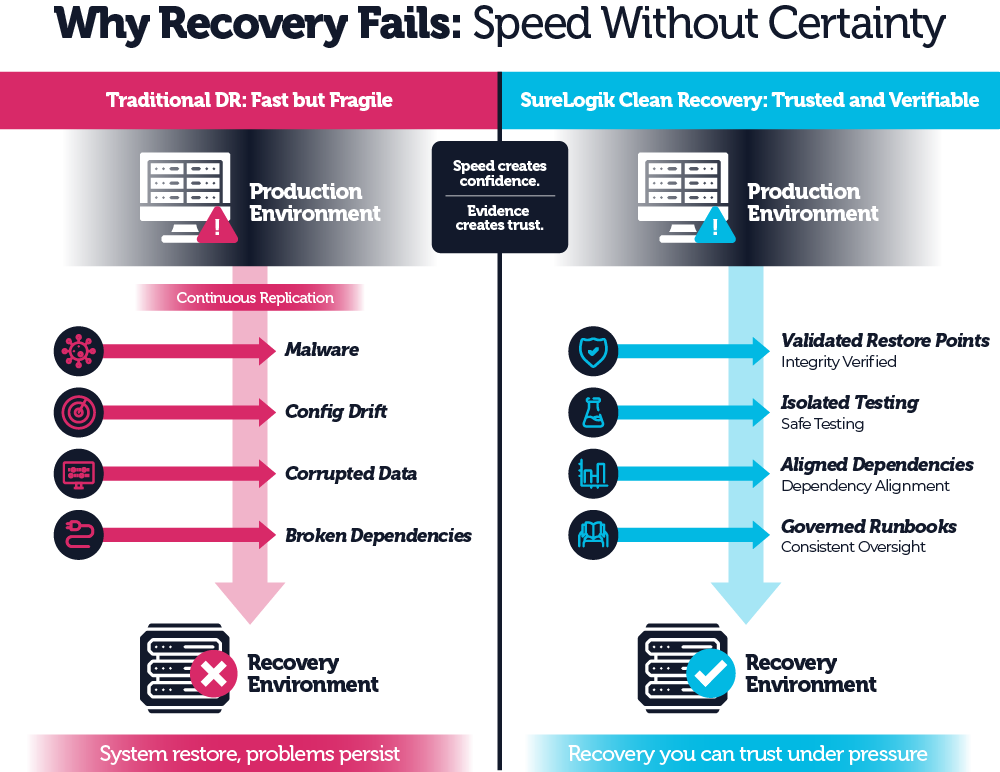
Traditional DR replicates everything in production, including:
- Hidden malware
- Configuration drift
- Data corruption
- Failed patches
- Unauthorised changes
- Dormant privileges
- Dependency misalignment
When these issues are replicated into recovery environments, systems may come back online, but the underlying problems remain. This results in recovery in name only.
Modern environments demand more. Recovery must be clean, not just fast.
The Hard Question IT Leaders Must Ask
Many organisations believe they have DR because backups exist, replication is active, or documentation is written. These components are necessary, but they do not prove recovery will work.
The real question is simple:
If disruption occurs tomorrow, can you trust your recovery?
Trust is earned through evidence, not assumption. Without end-to-end validation and consistent operational oversight, recovery remains theoretical.
Research shows that organisations typically test less than 60 percent of their documented DR procedures. This leaves up to 40 percent of recovery plans unproven. Even minor misalignment, as little as 5 to 10 percent across dependencies, can break failover entirely.
Why Unvalidated Recovery Creates Hidden Risk
| Recovery Gap | Why It Matters |
|---|---|
| Restore points unverified | Corruption or misconfiguration may be reintroduced |
| Dependencies assumed | Identity or integrations fail despite workload recovery |
| Testing incomplete | Gaps surface only during real disruption |
| Documentation outdated | Teams rely on memory and guesswork |
| Minor drift present | Small misalignment breaks full recovery |
This is why unvalidated recovery remains one of the most significant hidden risks in IT operations.
IT leaders are not struggling because they have done something wrong. They are constrained because environments change faster than traditional DR practices can keep up.
What Clean Recovery Really Means
Clean recovery strengthens DR by ensuring restored systems are dependable and free from hidden issues. It is built on four core principles.
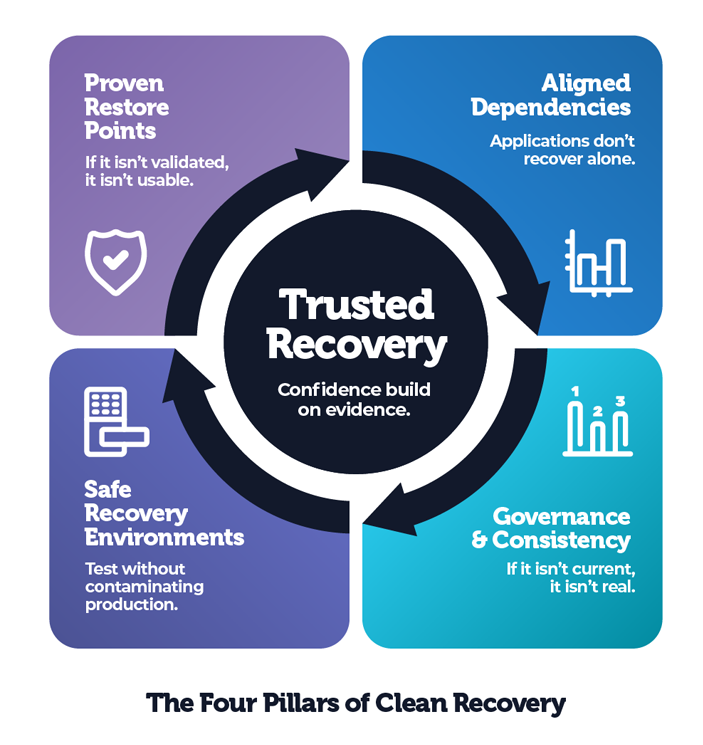
1. Proven Restore Points
Only restore points that pass integrity validation should ever be used.
2. Safe Recovery Environments
Workloads are restored and tested in controlled isolation to prevent contamination of production.
3. Aligned Dependencies
Applications return with everything they rely on. If identity, integrations, or policies fail, the recovery fails.
4. Governance and Consistency
Runbooks and workflows must reflect current production reality. Outdated documentation creates operational drift.
Clean recovery replaces uncertainty with evidence. It turns recovery into an operational guarantee, not a technical guess.
Why Recovery Maturity Matters Now
Recovery maturity is now a board-level concern. The drivers are structural and universal.
- System complexity continues to rise
- Expectations from leaders and auditors are higher
- Production evolves faster than recovery environments
- Digital services are central to business delivery
Recovery maturity is not about predicting disruption. It is about ensuring the organisation continues operating when disruption occurs.
How SureLogik Strengthens Recovery
SureLogik focuses on dependable recovery as a measurable outcome. Before technology is discussed, the operational foundation for recovery is established.
- Guided Recovery Validation
Structured testing and controlled failover exercises that show what works and what does not. - Clean Recovery Applied to Your Environment
Validated restore points, safe test environments, and dependable restoration workflows. - Governance and Operational Readiness
Aligned runbooks, procedures, and ongoing operational oversight that evolves with production. - Specialist Recovery Expertise
Support from recovery architects and engineers who strengthen readiness from day one.
The outcome is simple. Recovery becomes something the organisation can rely on, not a set of assumptions waiting for a crisis.
Ready to Strengthen Recovery?
See how dependable recovery performs inside your own environment.
Begin your guided introduction to the SureLogik 30-day recovery experience and evaluate clean, proven recovery with specialists who strengthen readiness at every step.