
What Is the 3-2-1 Backup Rule?
The 3-2-1 backup rule is a practical method for protecting business data against hardware failure, accidental deletion, cyberattacks and other disruptions.
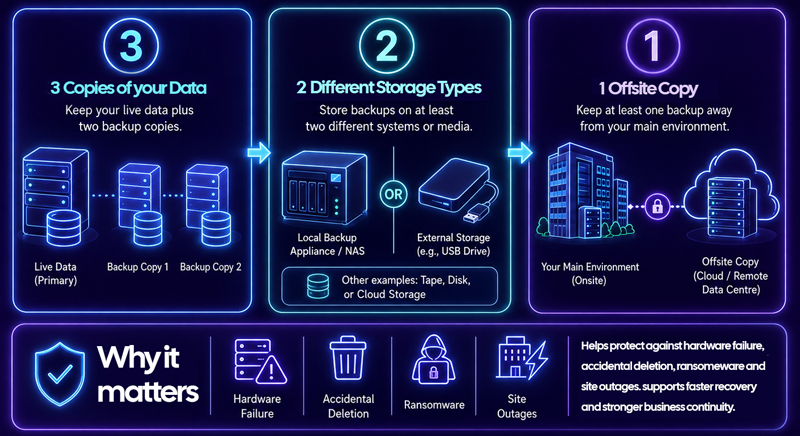
It recommends keeping:
- 3 copies of your data
- 2 different types of storage
- 1 copy stored offsite
The three copies include your original production data and two backup copies. Keeping multiple copies reduces the risk of a single failure leaving the business without recoverable information.
The two backup copies should be stored on different systems or types of media. For example, one copy could be held on local backup infrastructure, while another is stored in a secure cloud environment. This protects the organisation from an incident that affects a particular storage platform.
At least one copy should be stored away from the primary business environment. An offsite backup can remain available if the main location is affected by fire, flooding, theft, infrastructure failure or ransomware.
What does the 3-2-1 rule look like in practice?
A business might store its live data on company servers, maintain a backup on a separate local appliance and send another encrypted copy to a cloud-based backup platform.
This creates several recovery options. Local backups can support faster restoration after routine incidents, while the offsite copy provides additional protection when the primary environment has been damaged or compromised.
How does the 3-2-1 rule support BDR?
Backup and Disaster Recovery, commonly referred to as BDR, covers more than retaining copies of data. It defines how an organisation will restore its systems, applications and information after a serious disruption.
The 3-2-1 rule provides an important foundation for BDR by ensuring that recovery data is available from more than one source. However, an effective BDR strategy must also consider:
- Which systems and data must be restored first
- How much data loss the business can tolerate
- How quickly services need to be restored
- Who is responsible for each stage of recovery
- How employees and customers will be supported during an outage
These requirements are often defined through a Recovery Point Objective and a Recovery Time Objective.
The Recovery Point Objective, or RPO, determines how much recent data the organisation can afford to lose. The Recovery Time Objective, or RTO, defines how quickly a system or service must be restored.
For example, a system backed up once every 24 hours could lose almost a full day of information if it fails shortly before the next backup. This may be acceptable for a low-priority archive, but not for a financial platform, legal document system or operational aviation application.
BDR planning therefore helps the organisation decide how frequently backups should run, where they should be stored and which recovery technologies are required.
Does the 3-2-1 rule protect against ransomware?
The 3-2-1 rule provides a strong starting point, but backup copies must also be protected from unauthorised access, alteration and deletion.
Modern data protection strategies often include immutable or offline copies that cannot be changed during a defined retention period. Backup accounts should use strong access controls, and backup systems should be separated from standard administrative accounts where possible.
Recovery procedures must also be tested regularly. A successful backup job does not automatically confirm that systems, applications and data can be restored within the timeframes required by the business.
Testing helps identify missing data, configuration problems, access issues and recovery delays before a real incident occurs.
Backup is one part of business continuity
Backups protect information, while BDR provides the process for restoring business operations. Depending on the organisation, this may include cloud recovery environments, system replication, alternative infrastructure and documented recovery procedures.
The appropriate approach will depend on the importance of each workload, its recovery requirements and the financial impact of downtime.
The 3-2-1 rule remains useful because it prevents organisations from relying on one system, one location or one recovery method. It can be applied across physical infrastructure, cloud platforms and hybrid environments.
SureLogik helps organisations develop and manage data protection and BDR strategies that support reliable backup, recovery and business continuity. Through our services and strategic technology partnerships, we help businesses protect critical information, define recovery priorities and prepare for disruption before it affects operations.