
What Is Endpoint Security? A Complete Guide for Businesses
Modern businesses depend on a growing number of connected devices, making effective device protection essential. Laptops, desktops, smartphones, tablets, servers and other endpoints are vital for productivity, collaboration and customer service, yet each also represents a potential entry point for cyber threats.
As organisations adopt hybrid work models, cloud applications and mobile workforces, protecting endpoints has become a fundamental part of cybersecurity strategy.
Endpoint security has moved beyond traditional antivirus software. Modern organisations increasingly rely on a combination of Endpoint Protection Platforms (EPP), Endpoint Detection and Response (EDR), and Managed Detection and Response (MDR) services to protect users, devices and business data against sophisticated cyber threats.
Understanding how these capabilities work together is essential for building a resilient cybersecurity strategy.
What Is Endpoint Security?
Endpoint security is the practice of protecting devices that connect to a business network from cyber threats, unauthorised access and malicious activity. An endpoint is any device that communicates with a network.
Common examples include:
- Employee laptops and desktops
- Smartphones and tablets
- Company-owned and remote work devices
- Servers
- Virtual machines
- Internet of Things (IoT) devices
Endpoint security combines technologies, policies, monitoring and response capabilities to help detect, prevent and contain threats targeting these devices.
Unlike traditional antivirus software, modern protection solutions are designed to address a broader range of threats and provide greater visibility across the organisation’s environment.
Why Modern Businesses Need Stronger Endpoint Protection
The way people work has changed significantly over the last decade.
Employees frequently access business applications from multiple locations using various devices. Cloud services have reduced reliance on traditional office networks, while remote and hybrid work models have expanded the number of endpoints that require protection.
This shift creates new challenges for IT and security teams:
- More devices connecting to business systems
- Increased use of cloud-based applications
- Employees working outside traditional network boundaries
- Greater risk of compromised credentials
- Expanded opportunities for cybercriminals to target users and devices
Because endpoints often store, access or transmit sensitive business data, they are frequently targeted by attackers seeking access to larger systems and networks.
Why Traditional Antivirus Alone Is No Longer Enough
For many years, antivirus software has formed the foundation of endpoint protection strategies.
Traditional antivirus solutions remain an important security control and continue to help organisations identify and block many known threats. However, the threat environment has become increasingly complex.
Modern attackers frequently use techniques designed to avoid detection by traditional signature-based security tools. Many modern attacks also focus on compromised identities, stolen credentials, and user access rather than traditional malware alone.
As a result, organisations increasingly require additional capabilities that extend beyond traditional antivirus protection.
Modern protection strategies often combine:
- Endpoint Protection Platforms (EPP) for preventive controls
- Endpoint Detection and Response (EDR) for threat visibility and investigation
- Managed Detection and Response (MDR) for continuous monitoring and response support
- Security awareness training and identity protection measures
- Patch management and device management controls
Rather than replacing antivirus software, these capabilities work together to create a layered security strategy that helps organisations identify, contain and respond to a broader range of cyber threats.
Endpoint Security in Remote and Hybrid Work Environments
Remote and hybrid work have significantly increased the number of endpoints organisations must protect. Employees regularly access business applications and data from multiple locations using laptops, mobile devices and cloud services.
This can create additional security challenges, including:
- Devices connecting from unmanaged networks
- Increased reliance on cloud applications
- Greater exposure to phishing and credential-based attacks
- Delays in applying updates to remote devices
Because endpoints often operate outside the traditional network perimeter, organisations need security controls that provide consistent visibility and protection regardless of where users work.
Common Endpoint Security Threats
Organisations face a range of endpoint-related threats, including:
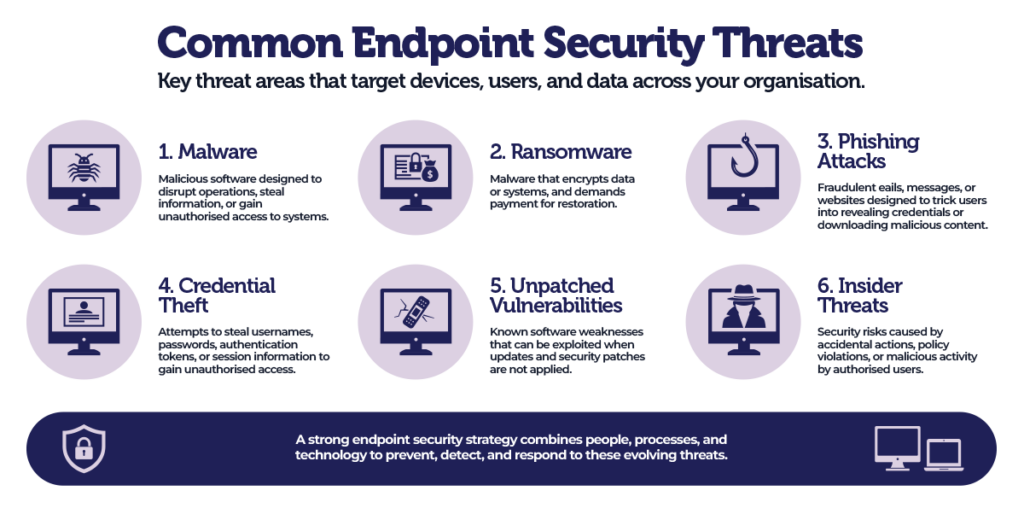
- Malware: Malicious software designed to disrupt operations, steal information or gain unauthorised access to systems.
- Ransomware: Malware that encrypts data or systems and demands payment for restoration.
- Phishing attacks: Fraudulent emails, messages, or websites designed to trick users into revealing credentials or downloading malicious content.
- Credential theft: Attempts to steal usernames, passwords, authentication tokens, or session information to gain unauthorised access.
- Unpatched vulnerabilities: Known software weaknesses that can be exploited when updates and security patches are not applied.
- Insider threats: Security risks caused by accidental actions, policy violations, or malicious activity by authorised users.
How Endpoint Security Works
Modern endpoint security combines multiple layers of protection designed to prevent, detect, investigate, and respond to threats.
These capabilities typically include:
- Threat prevention: Blocking known threats before they execute on a device.
- Threat detection: Monitoring endpoint activity for suspicious behaviour and indicators of compromise.
- Investigation and visibility: Providing security teams with insight into endpoint activity and potential incidents.
- Response and containment: Helping isolate affected devices and limit the spread of threats.
Together, these capabilities help organisations strengthen endpoint protection and improve security operations.
The Shift from Prevention to Detection and Response
Cybersecurity threats continue to change, driving the development of more advanced security strategies.
Historically, organisations relied primarily on antivirus endpoint protection to identify and block known threats. While these controls remain important, modern attacks often involve techniques designed to bypass traditional signature-based detection methods.
As a result, organisations increasingly combine multiple layers of protection and response capabilities.
Endpoint Protection Platforms (EPP)
Endpoint Protection Platforms provide foundational security controls designed to prevent threats from executing on endpoint devices. EPP solutions primarily focus on prevention, while EDR and MDR add visibility, investigation and response capabilities.
Capabilities may include:
- Antivirus and anti-malware protection
- Application control
- Device control
- Web filtering
- Policy enforcement
Endpoint Detection and Response (EDR)
Endpoint Detection and Response solutions extend beyond prevention by continuously monitoring endpoint activity for indicators of suspicious behaviour.
EDR capabilities help organisations:
- Collect and analyse endpoint telemetry
- Detect potential security incidents
- Investigate endpoint activity
- Analyse attack patterns
- Support incident response efforts
Managed Detection and Response (MDR)
Many organisations recognise the value of advanced detection capabilities but may not have the internal resources to continuously monitor security events.
Managed Detection and Response (MDR) services combine security technologies, security monitoring, and specialised human expertise to help organisations detect, investigate and respond to potential threats.
MDR services typically support organisations by:
- Monitoring security alerts and endpoint activity
- Investigating suspicious events
- Assisting with threat containment and response
- Providing access to cybersecurity expertise
- Improving visibility across the endpoint environment
For businesses with limited security resources, MDR can provide an additional layer of operational support that complements endpoint protection technologies.
Best Practices for Strengthening Endpoint Security
Businesses can improve endpoint protection by:
- Maintaining visibility of managed and unmanaged devices across the environment
- Applying security patches promptly
- Using reputable endpoint protection solutions
- Enabling multi-factor authentication
- Implementing least-privilege access controls
- Encrypting sensitive data where appropriate
- Monitoring endpoint activity continuously
- Training employees on cybersecurity awareness
- Developing and testing incident response procedures
- Reviewing security policies and configurations regularly
Benefits of Modern Endpoint Security Solutions
- Improved threat protection: Multiple security layers help reduce exposure to common cyber threats.
- Greater visibility: Centralised monitoring provides insight into endpoint activity across the organisation.
- Faster incident response: Improved visibility can help organisations investigate and respond more efficiently.
- Reduced operational risk: Protecting endpoints reduces the likelihood of business disruption from security incidents.
- Improved Business Continuity: Cybersecurity incidents can disrupt operations and affect access to critical systems. Effective security controls help organisations reduce the likelihood of endpoint-related disruptions by improving threat prevention, detection and response capabilities.
- Support for compliance requirements: Endpoint security can support broader compliance and governance initiatives by helping organisations implement security controls, improve visibility and demonstrate a proactive approach to protecting business systems and data.
Endpoint Security Is a Critical Part of Modern Cybersecurity
As organisations continue to embrace remote work, cloud services, and digital transformation initiatives, modern endpoint protection plays an increasingly important role in protecting business operations.
Every connected device represents both an opportunity for productivity and a potential target for cyber threats. A well-designed endpoint security strategy helps organisations improve visibility, reduce risk, and respond more effectively when threats emerge.
By combining endpoint protection technologies with strong security practices, continuous monitoring, and response capabilities, businesses can build a more resilient cybersecurity posture and better protect their users, data, and operations.
Protect Your Business With SureLogik
A well-designed security strategy helps organisations improve visibility.
Organisations need a layered approach that combines endpoint protection, threat detection, security monitoring, and response capabilities to address evolving cyber threats.
SureLogik helps businesses strengthen their cybersecurity posture through endpoint protection, Managed Detection and Response (MDR), Managed Data Protection (MDP), and broader cyber resilience services designed to support modern work environments and evolving security requirements.
Contact SureLogik to learn how our endpoint security and MDR services can help protect your users, devices, and business operations.